Own product, in development
Castweft
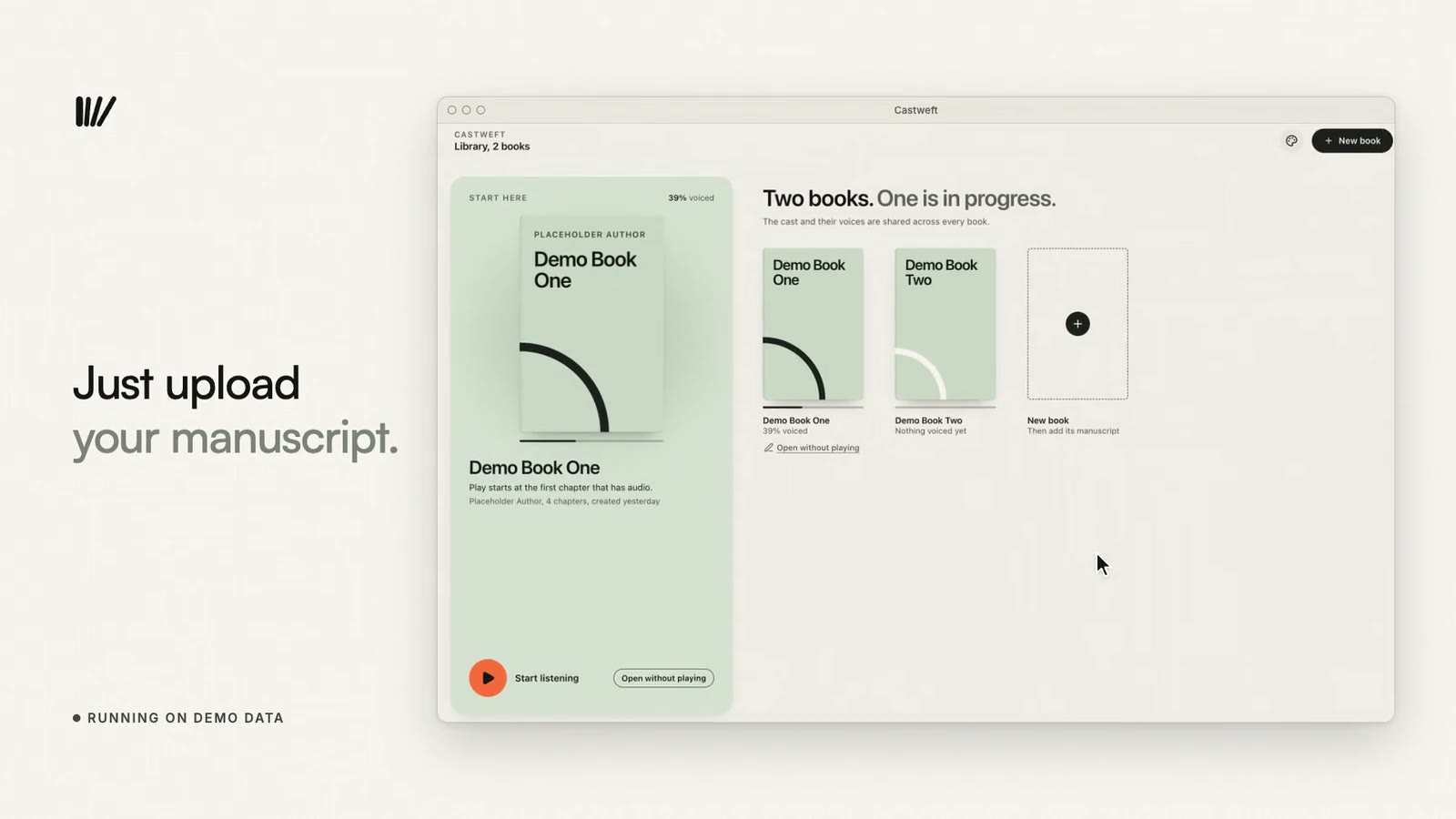
A working private prototype that turns a manuscript into a cast, voiced, sound-designed chapter on a Mac, with an iPhone listening app.
- Year
- 2026
- Status
- In development
- Name
- Working name
- Project Type
- Own product
- Skills
- UX & UIProduct designBrand designAI training
- Platform
- Mac appiPhone companion
- Built with
- Tauri 2, React, TypeScriptSwiftUIPython, FastAPI
- Shown
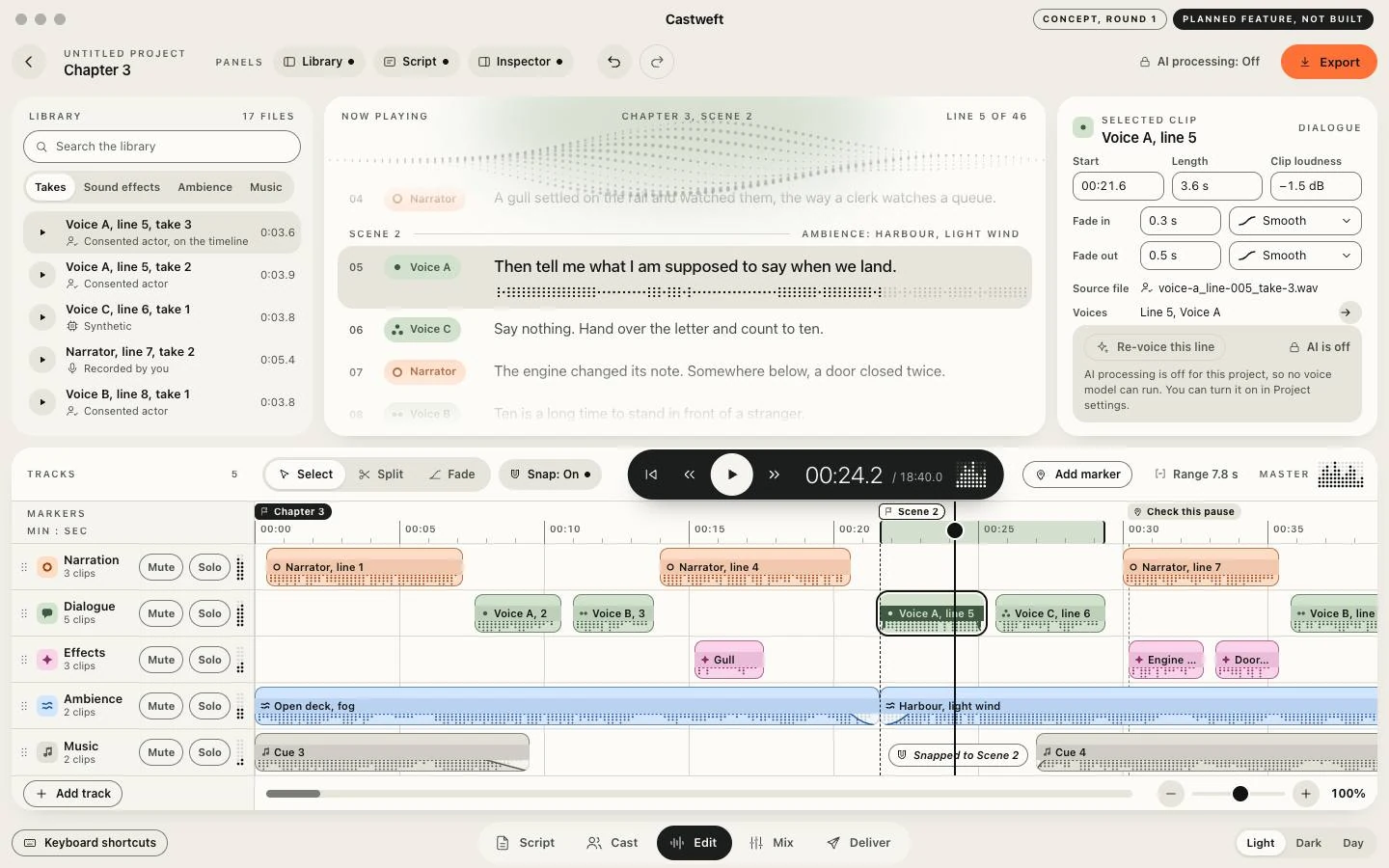
- Mac app on demo dataTimeline and iPhone screen in the film are designs
Short read
You make it
Produce chapter
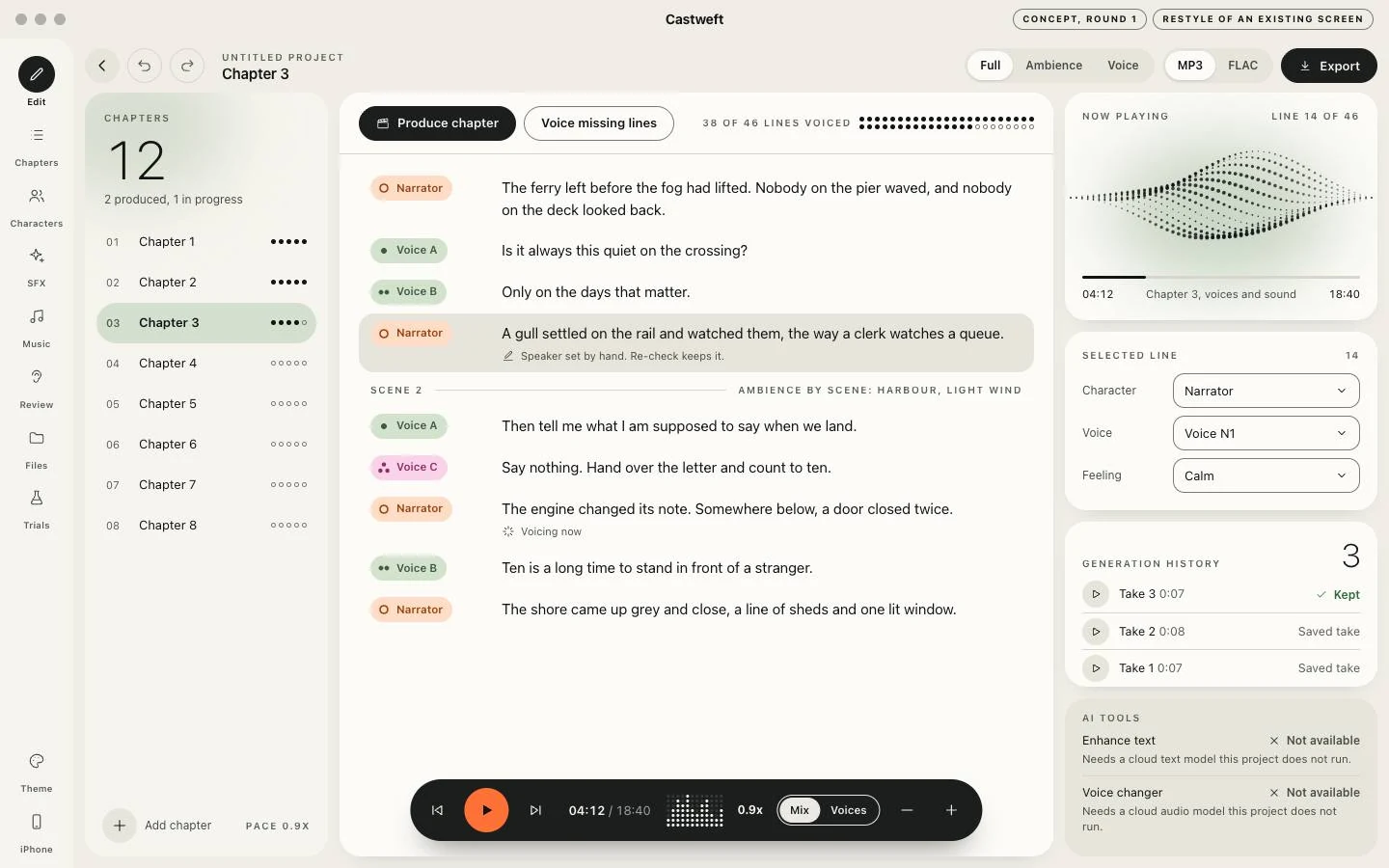
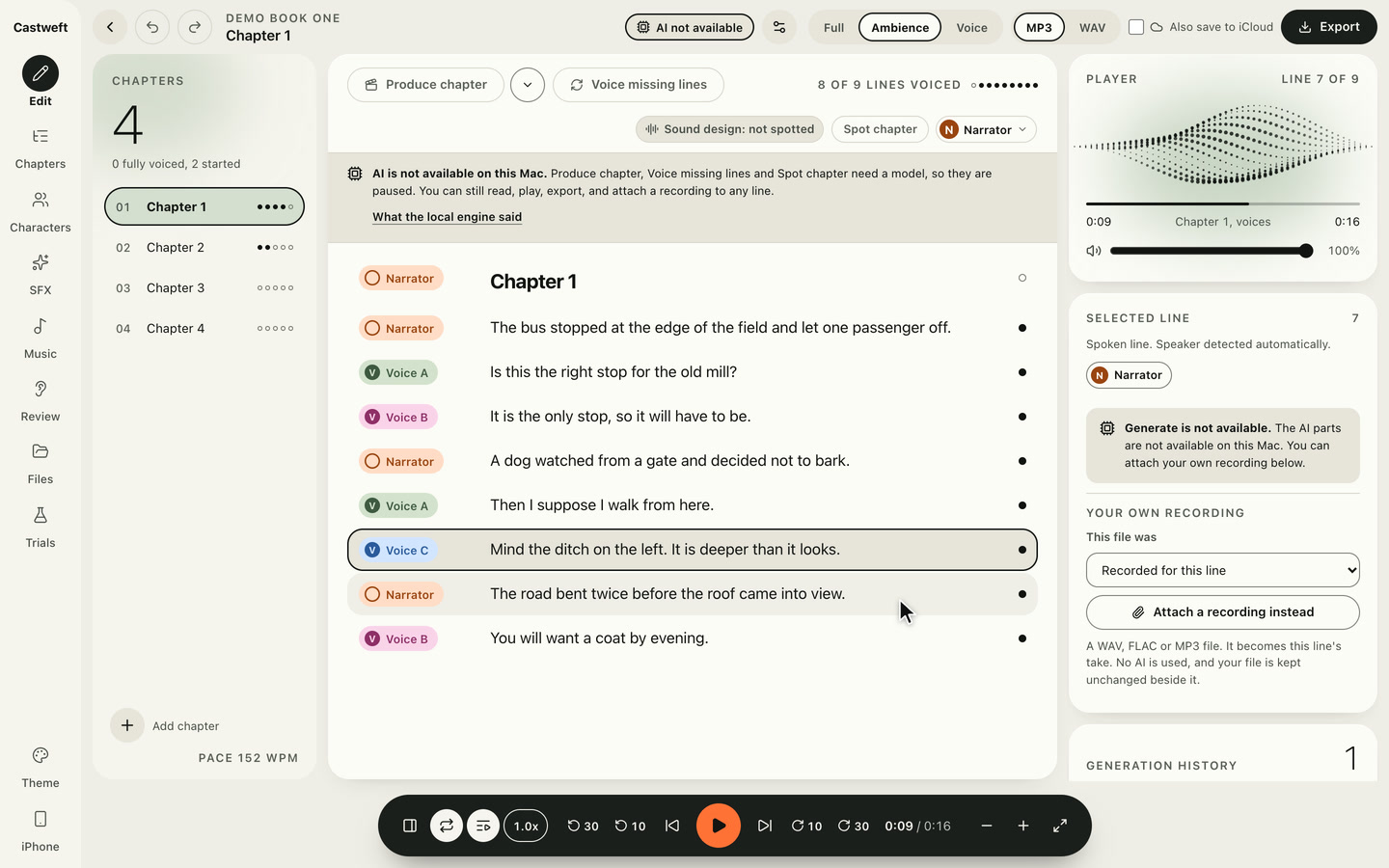
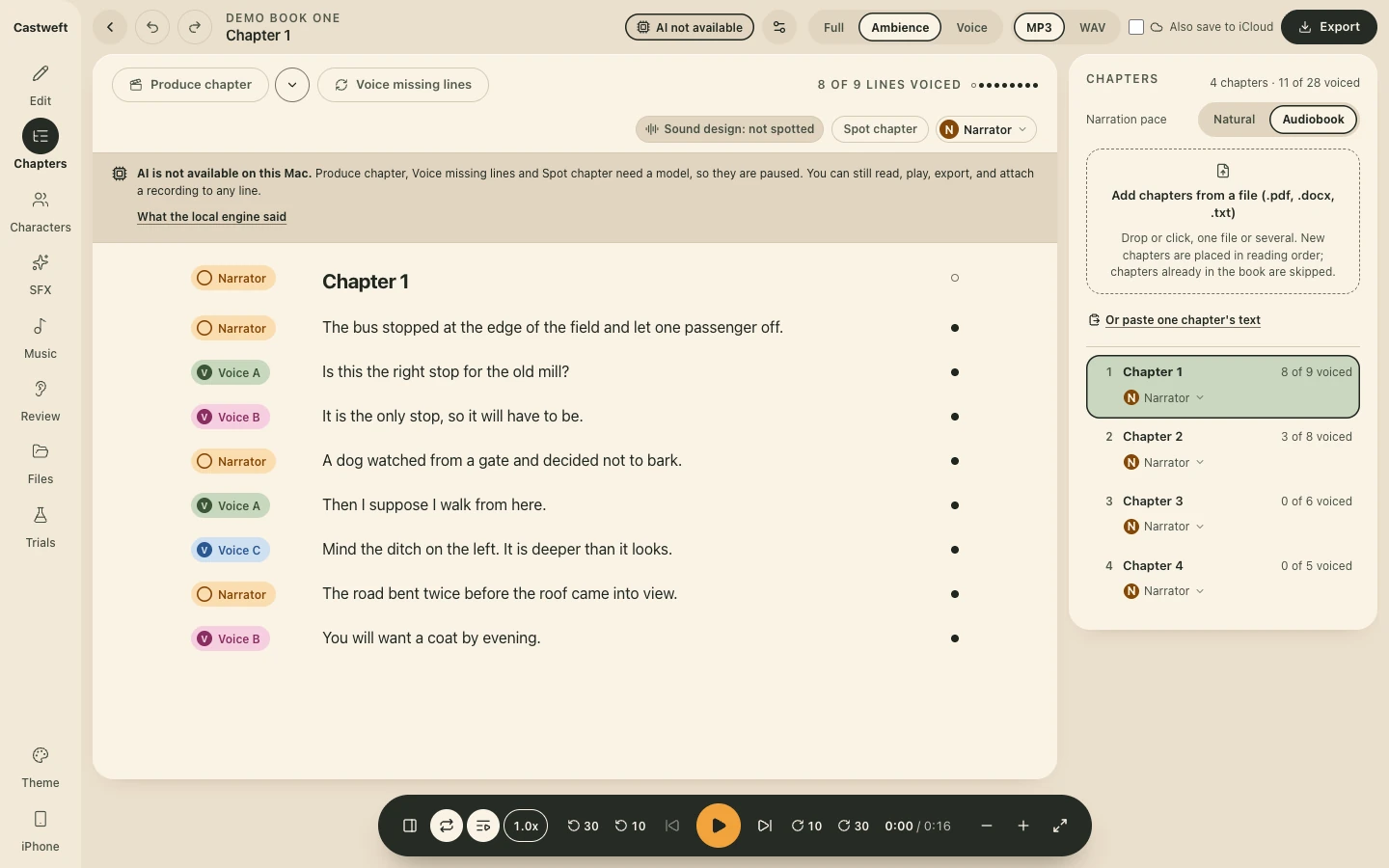
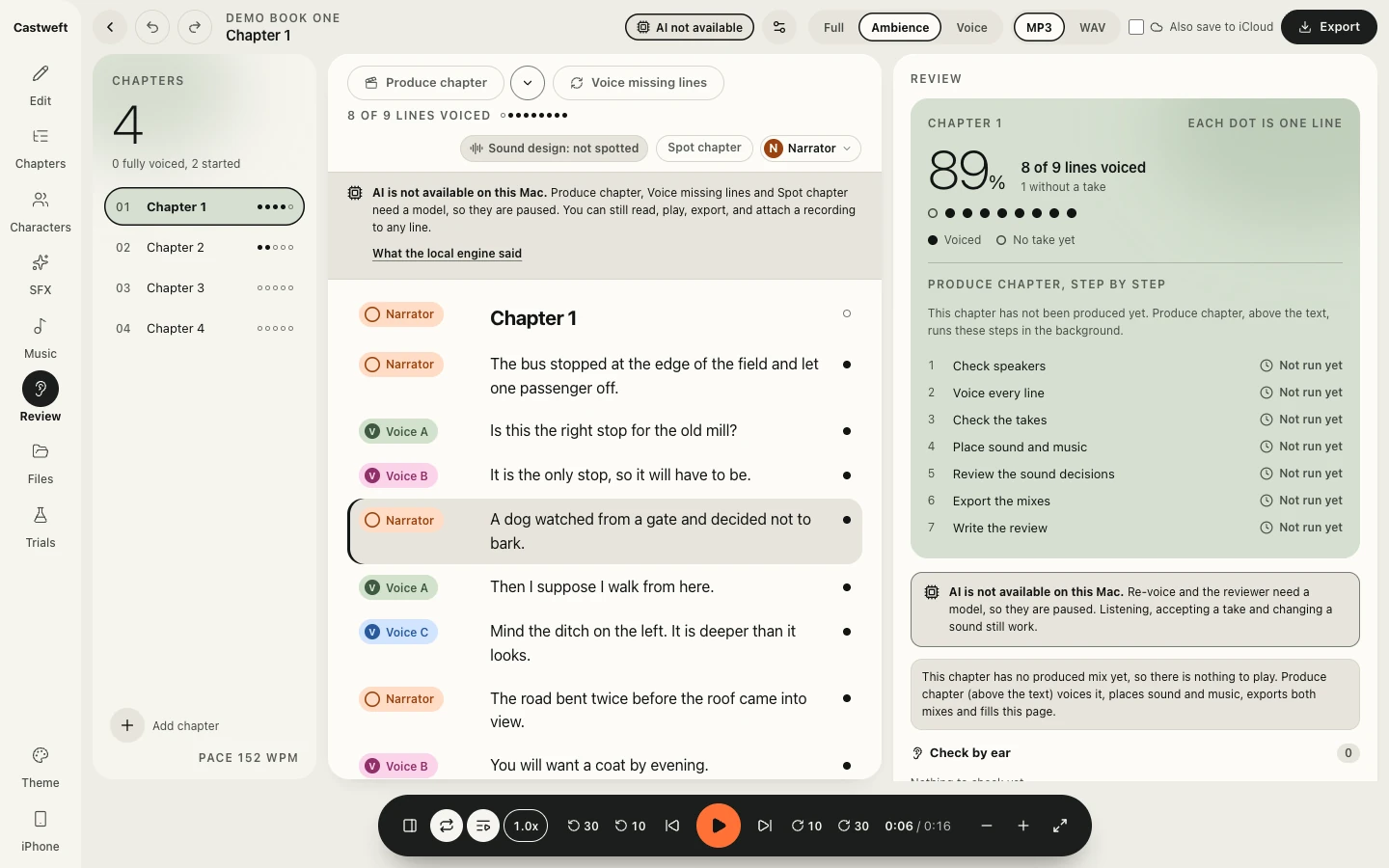
Manuscript import, speaker attribution, voicing, scene and cue spotting, a mix, review and export all exist in code.
Step 1 / 3 Library
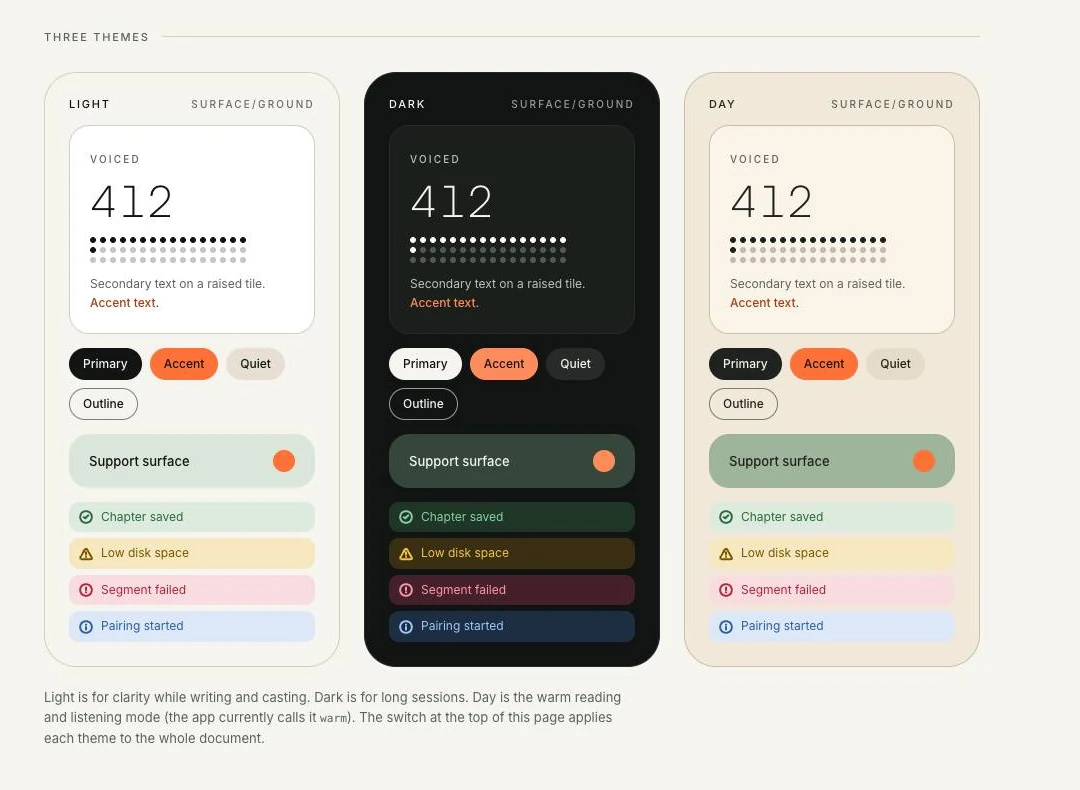
Light, Dark, Day
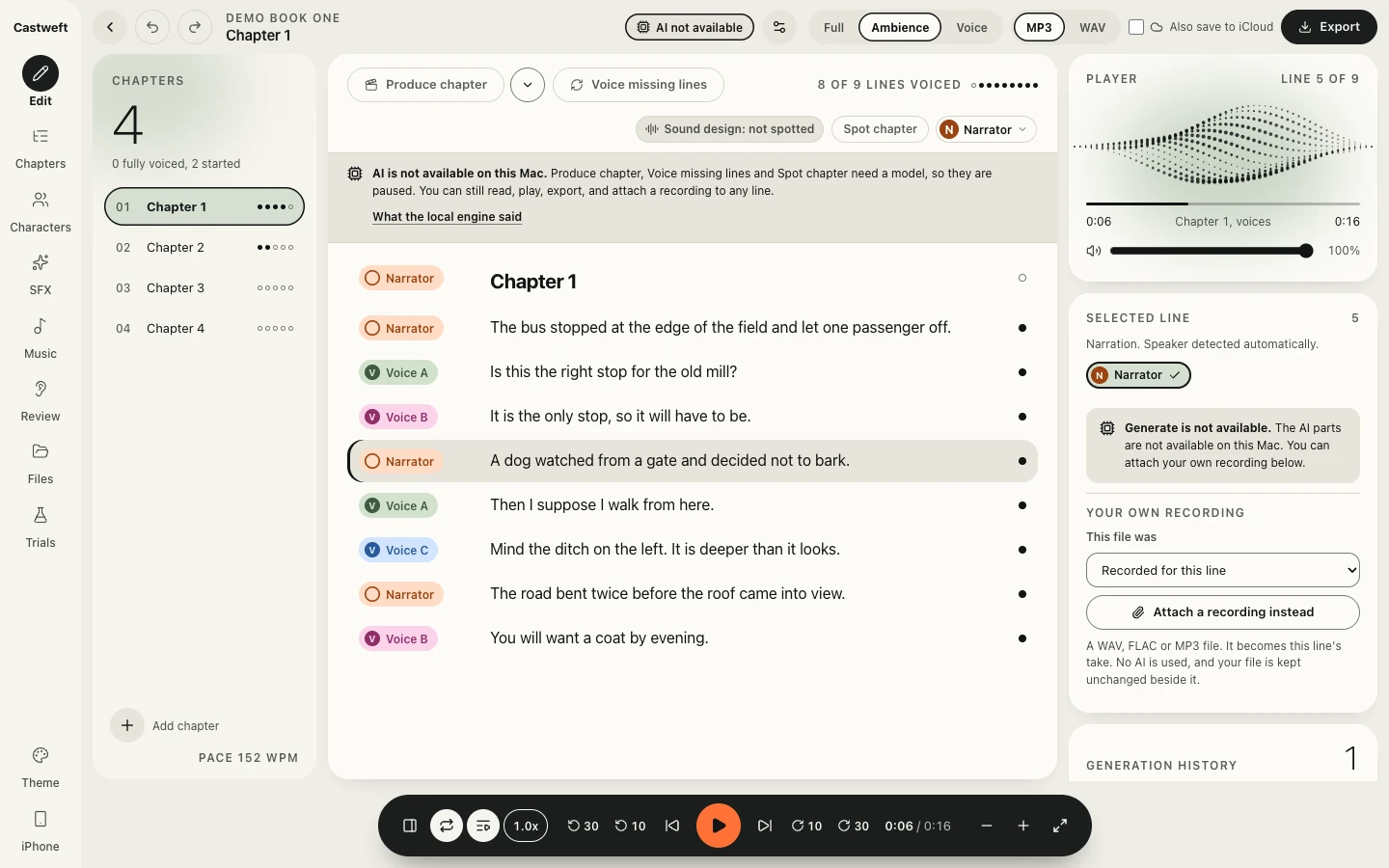
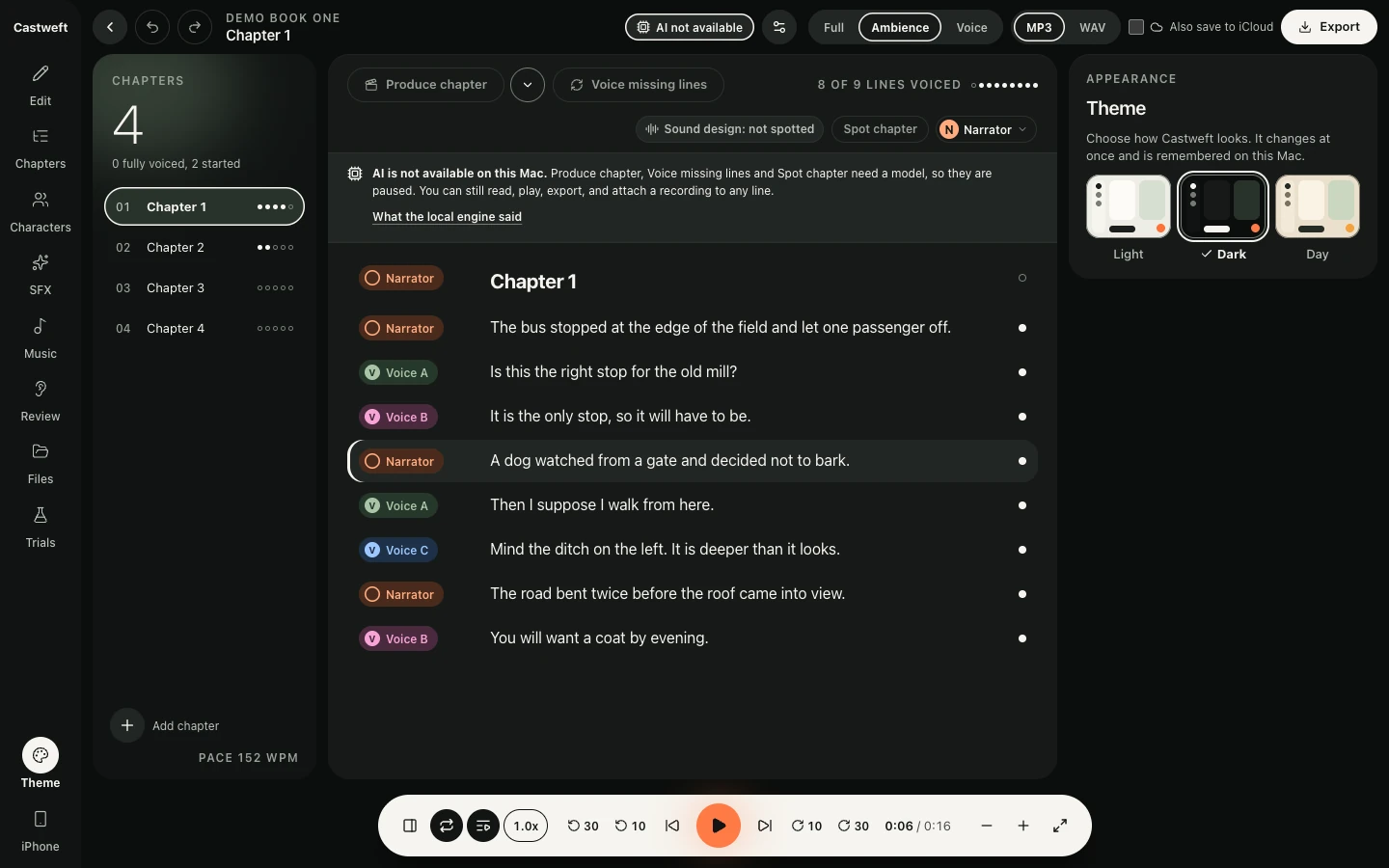
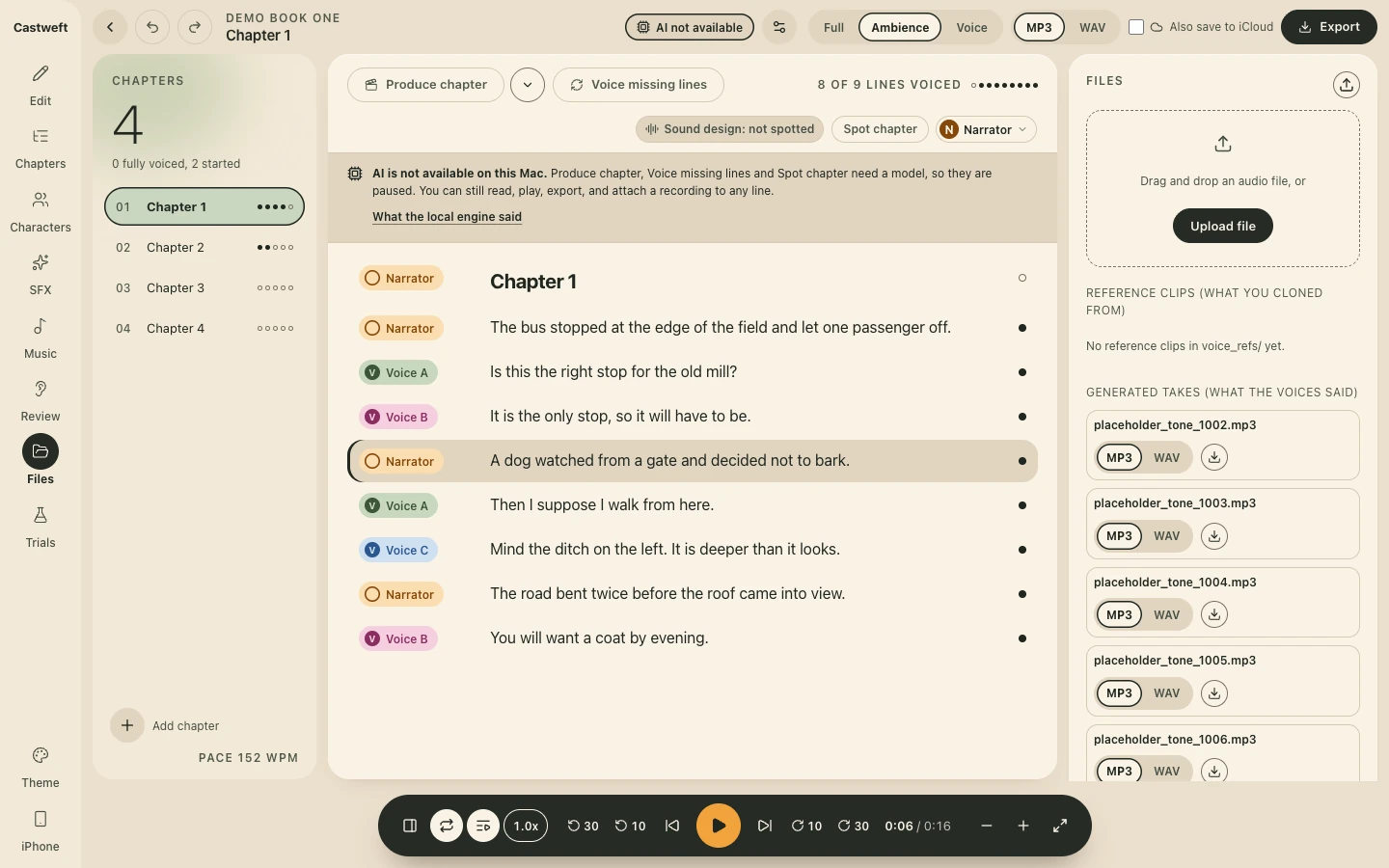
Step 1 / 3 Light
Connect to Your Mac
Voice Studio on your Mac does the voicing. This iPhone plays your books, downloads chapters for later, and can ask the Mac to voice new lines.
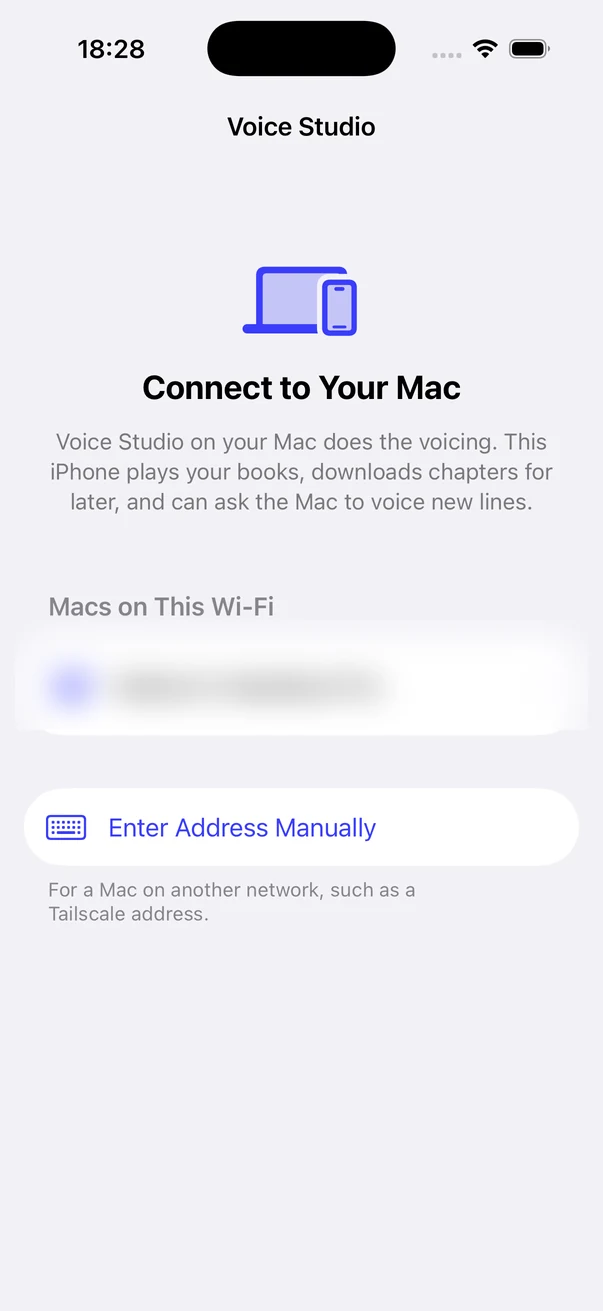
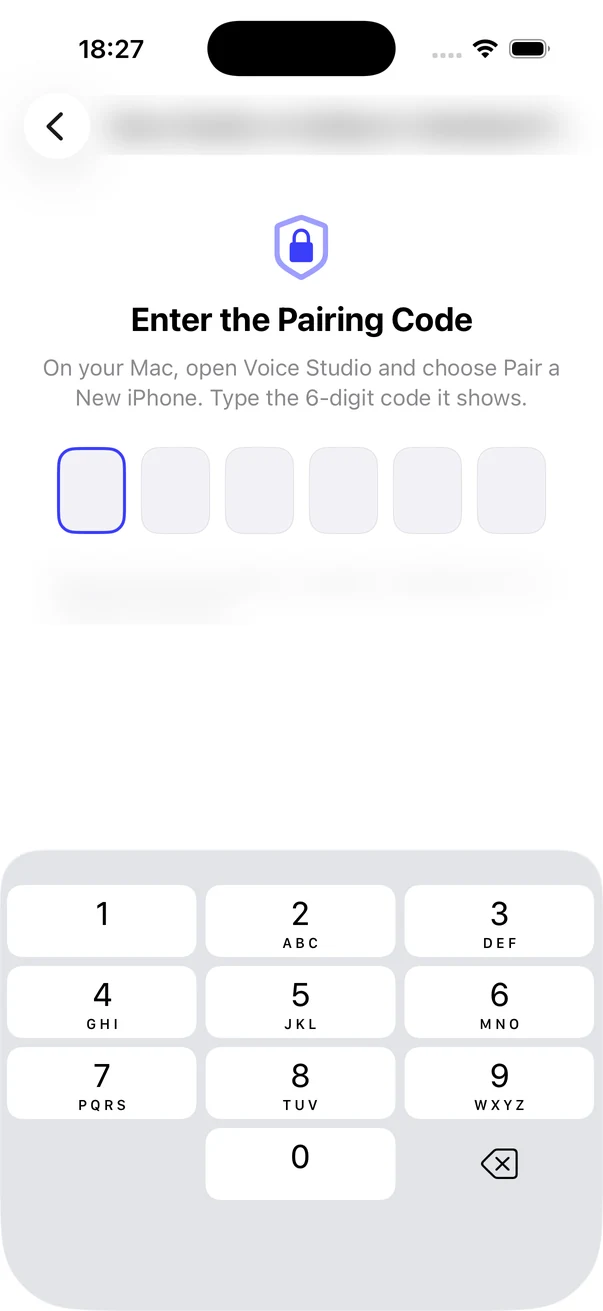
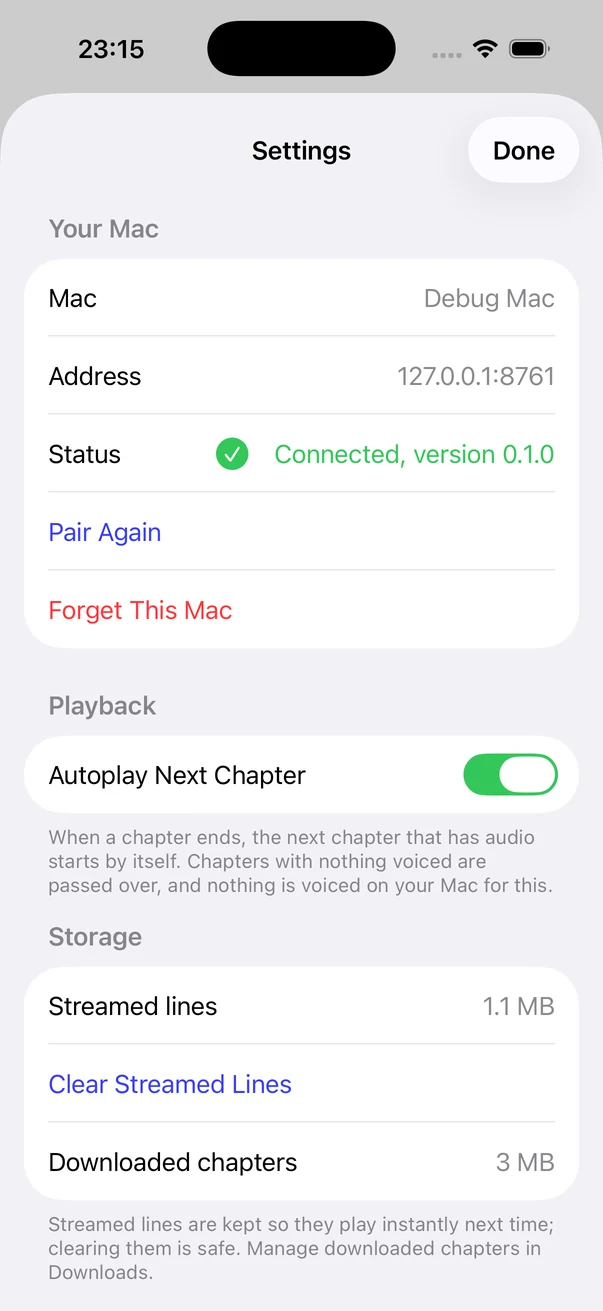
Simulator. Device name and address blurred.
Constraint and reflection
Constraint
“Needs to run offline, no API costs (you need a beefy computer to run it).”
Reflection
“Curiosity based learning is amazing and the product actually works.”
In development
The full process
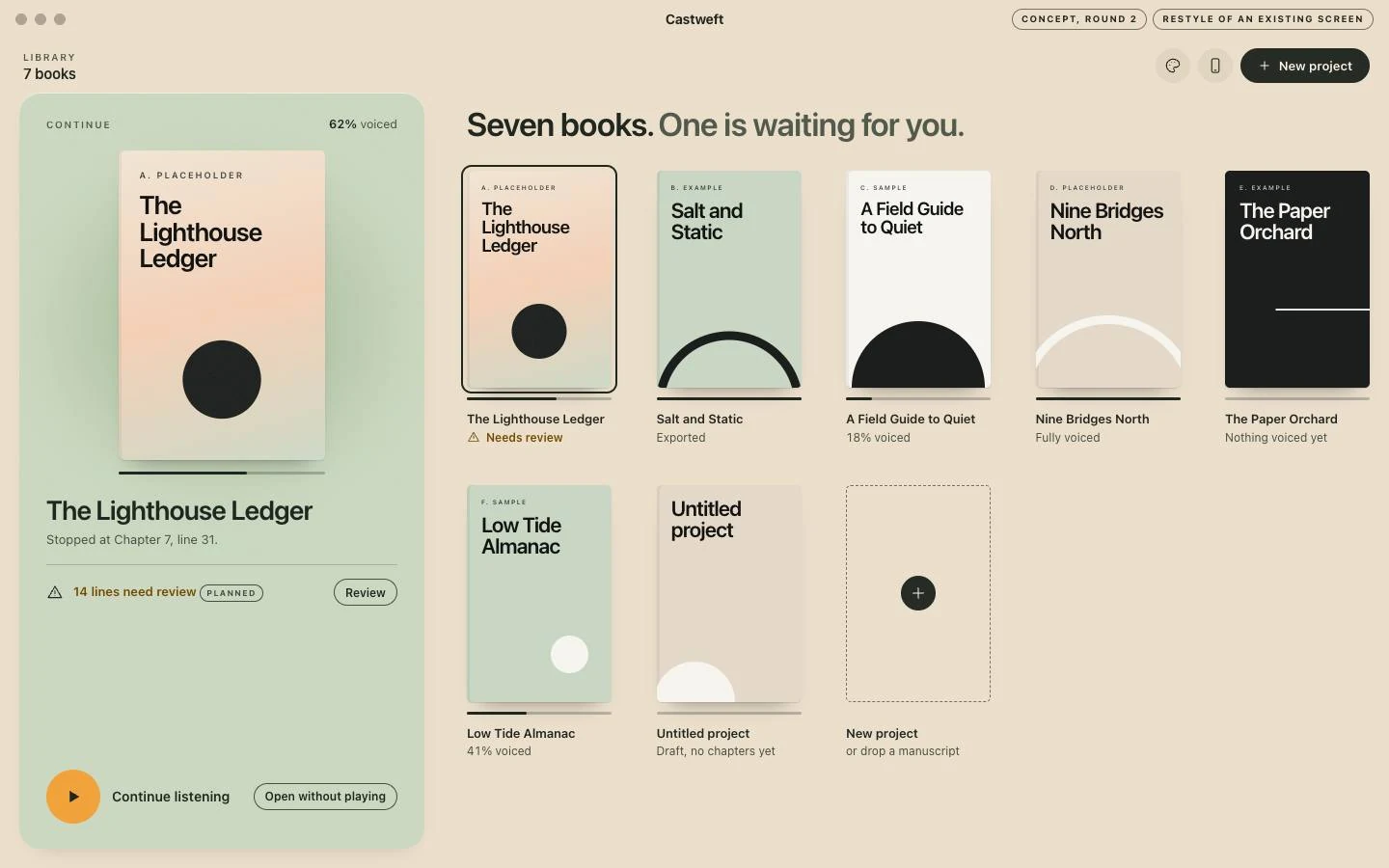
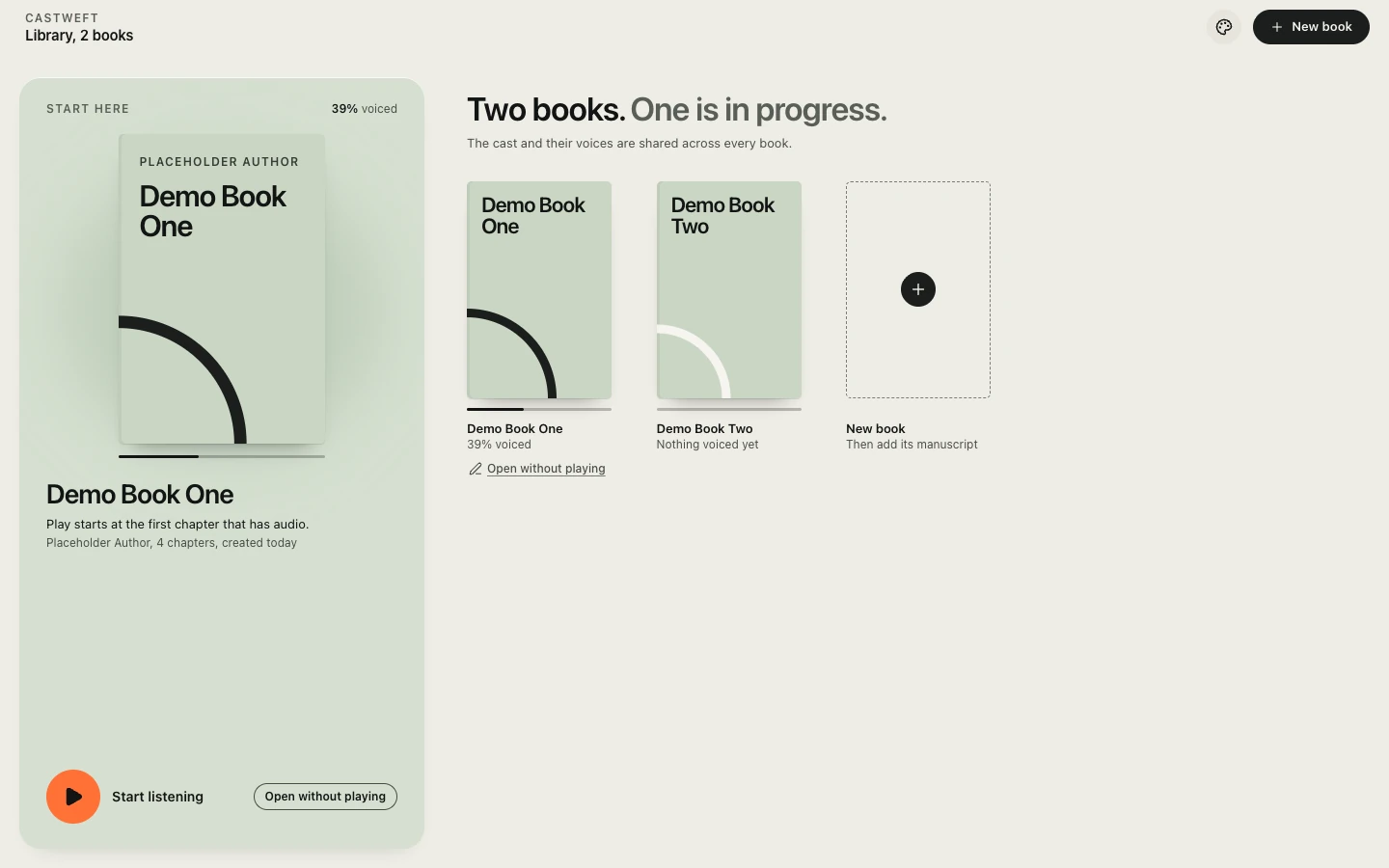
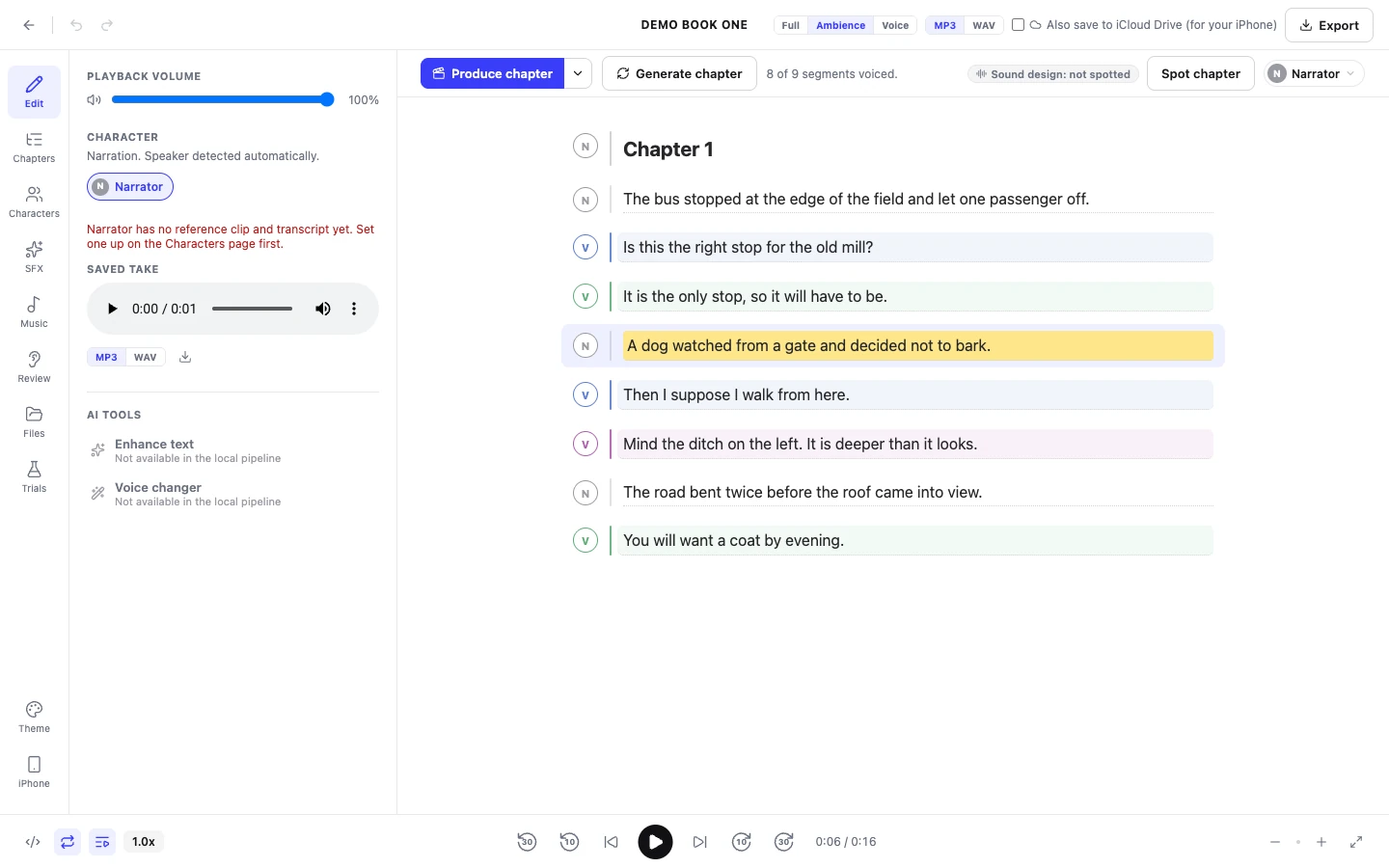
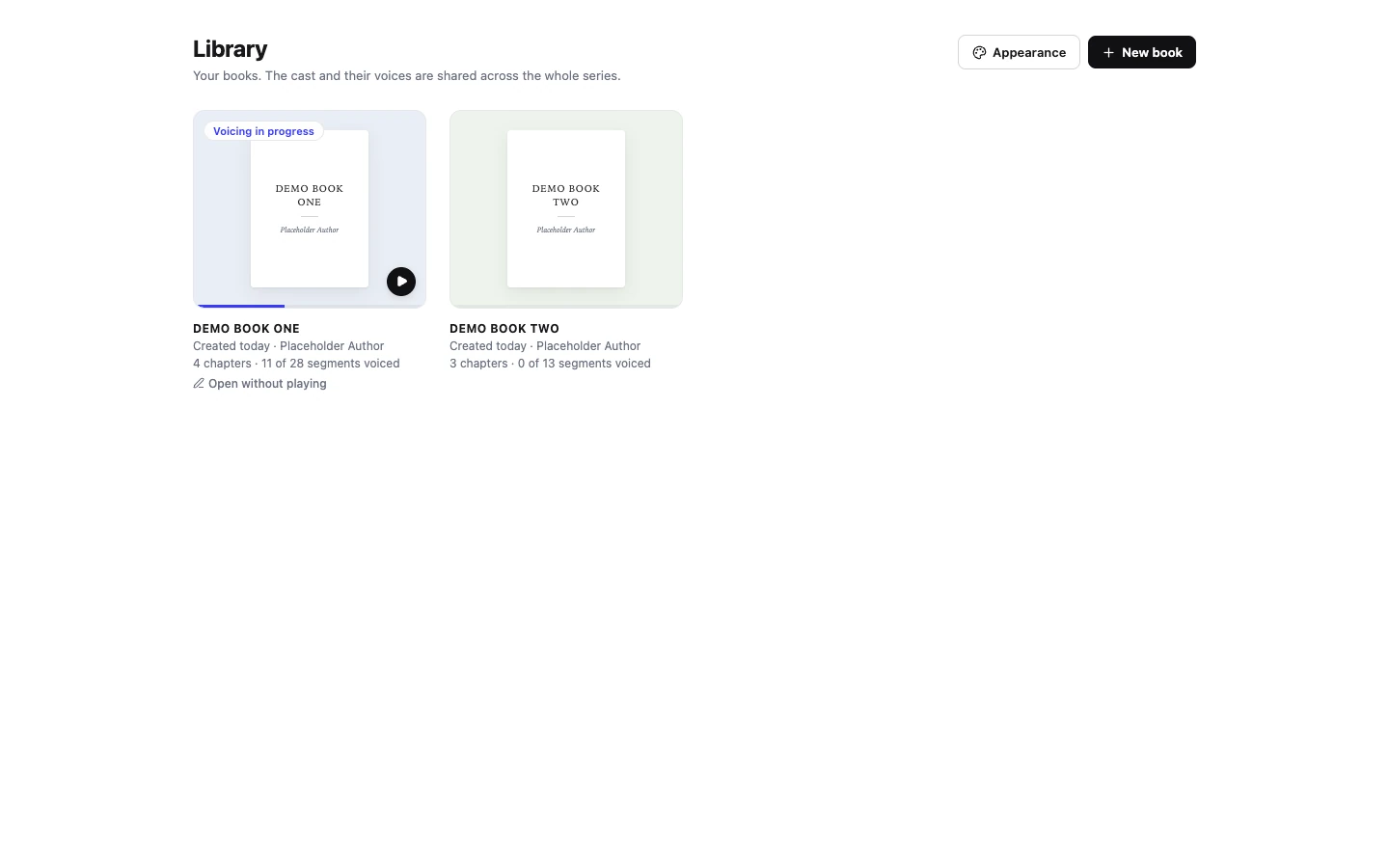
The app before and after the restyle of 9 October 2026, same screen, same invented library.
The concept sheets, round 1 to version 2 to version 2.1. Concepts with placeholder content, not the running app.
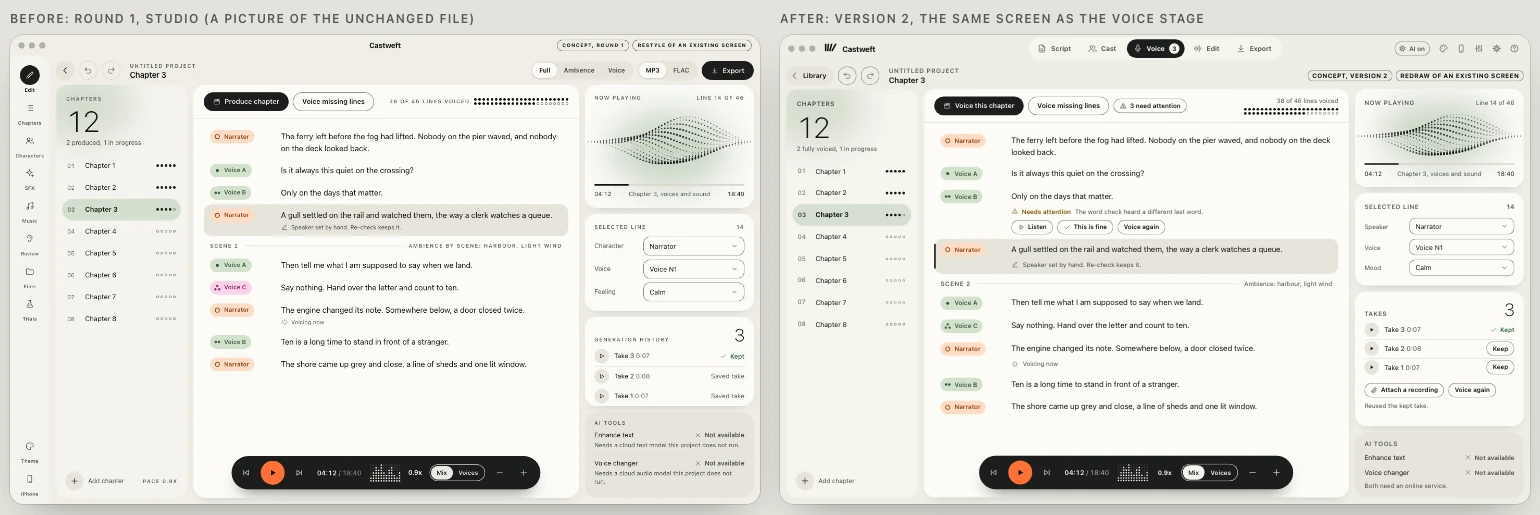
Kait's note on version 2: “we still need to work on the UI and padding”
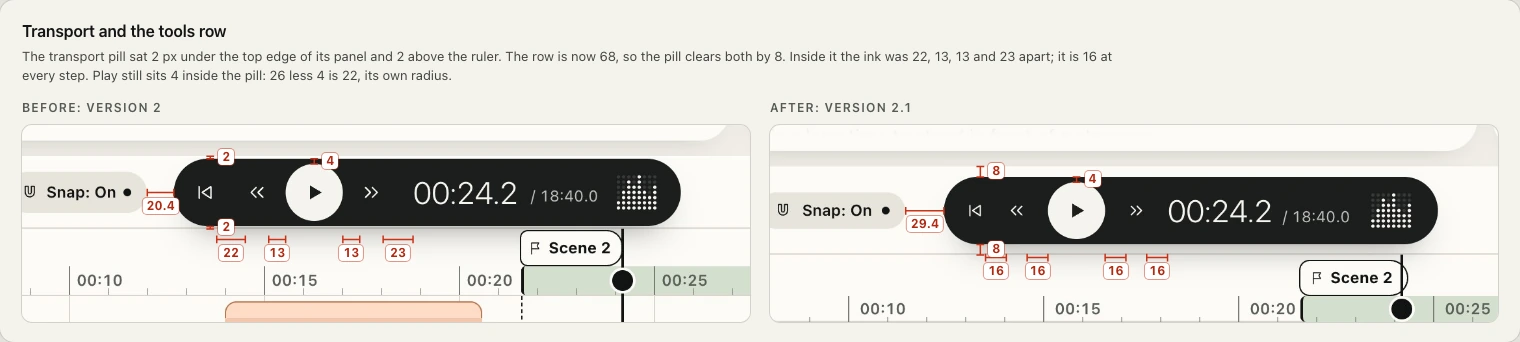
This pass changes spacing only. Every padding, margin and gap now comes from one 4 px scale; panes, tiles, rows, pills and chips each have one named padding; text starts on shared lines; nested corners relate. The navigation, the content, the colours and the words are version 2. Both sheets were measured with a script before and after (tools/measure.mjs); the numbers here are its output.
| Measured on all 13 screens | Version 2 | Version 2.1 |
|---|---|---|
| Distinct spacing values in use | 29 | 9 |
| of them off the 4 px scale | 22 | 0 |
| Declarations off the scale | 345 | 0 |
| Measured box insets and gaps off the scale | 98 | 0 |
| Siblings that differ for no reason | 6 | 0 |
| Text or icons off centre by over 1 px | 9 | 0 |
| Things closer than 8 px, not meant | 69 | 0 |
| Screens with uneven outer margins | 13 | 0 |
| Edges that miss a shared line | 7 | 0 |
| Nested radii that do not relate | 5 | 0 |
| Radii off the ladder | 6 | 0 |
| Control heights off the 4 px grid | 8 | 0 |
| Busiest 100 x 100 px, items | 15 | 12 |
| Places with 8 or more items in 100 x 100 px | 23 | 16 |
Brand foundations, draft 1, 9 October 2026. Colours and fonts are proposals.
Castweft turns written stories into sound.
It is a creative audio studio where voices, music and sound are woven around the text, with AI as help you can take or leave. The brand should feel like sound taking shape: round, warm and calm, with one thing moving.
The product sentence follows the chosen direction in 00_STATUS_AND_DECISIONS.md. That direction is planned, not shipped, so this is a brand idea and not website copy.
Five positions, taken from her sliders.
Redrawn from the positioning chart on the moodboard (image 18). Dot positions are read by eye. The orange dot is the one she highlighted.
Plain, warm, exact. The story is the hero and the tool stays quiet.
- ASay what is realPresent tense for what exists. “We are building” for what does not.
- BOne idea per lineShort sentences. Verbs first in buttons. No stacked adjectives.
- CTalk to an author“Your chapter”, “your cast”. Never “users” or “content”.
- DCalm when it breaksWhat happened, what to do next. No blame, no jokes, no “oops”.
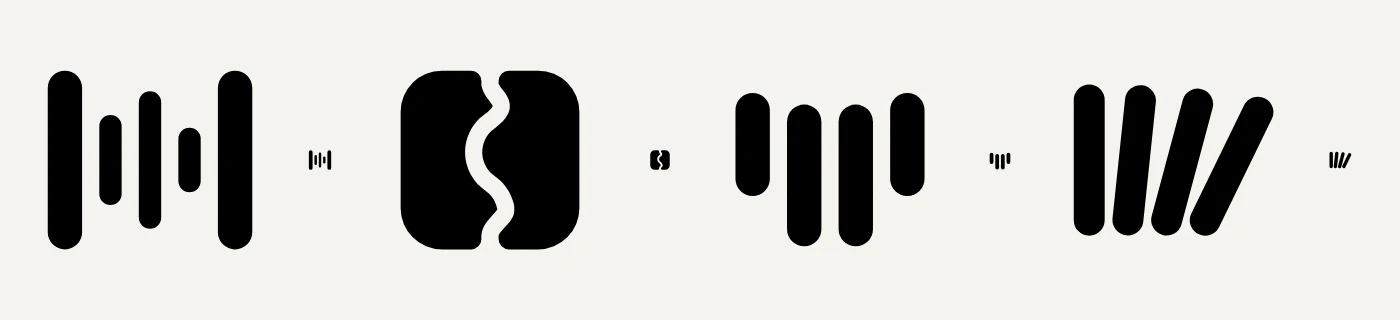
Logo: explorations of 9 October 2026, then the kit, v0.1. A direction, not trademark cleared, not signed off as final.


Captures of the running app with an invented library: placeholder books, placeholder lines, test tones in place of takes. The Characters screen is left out.
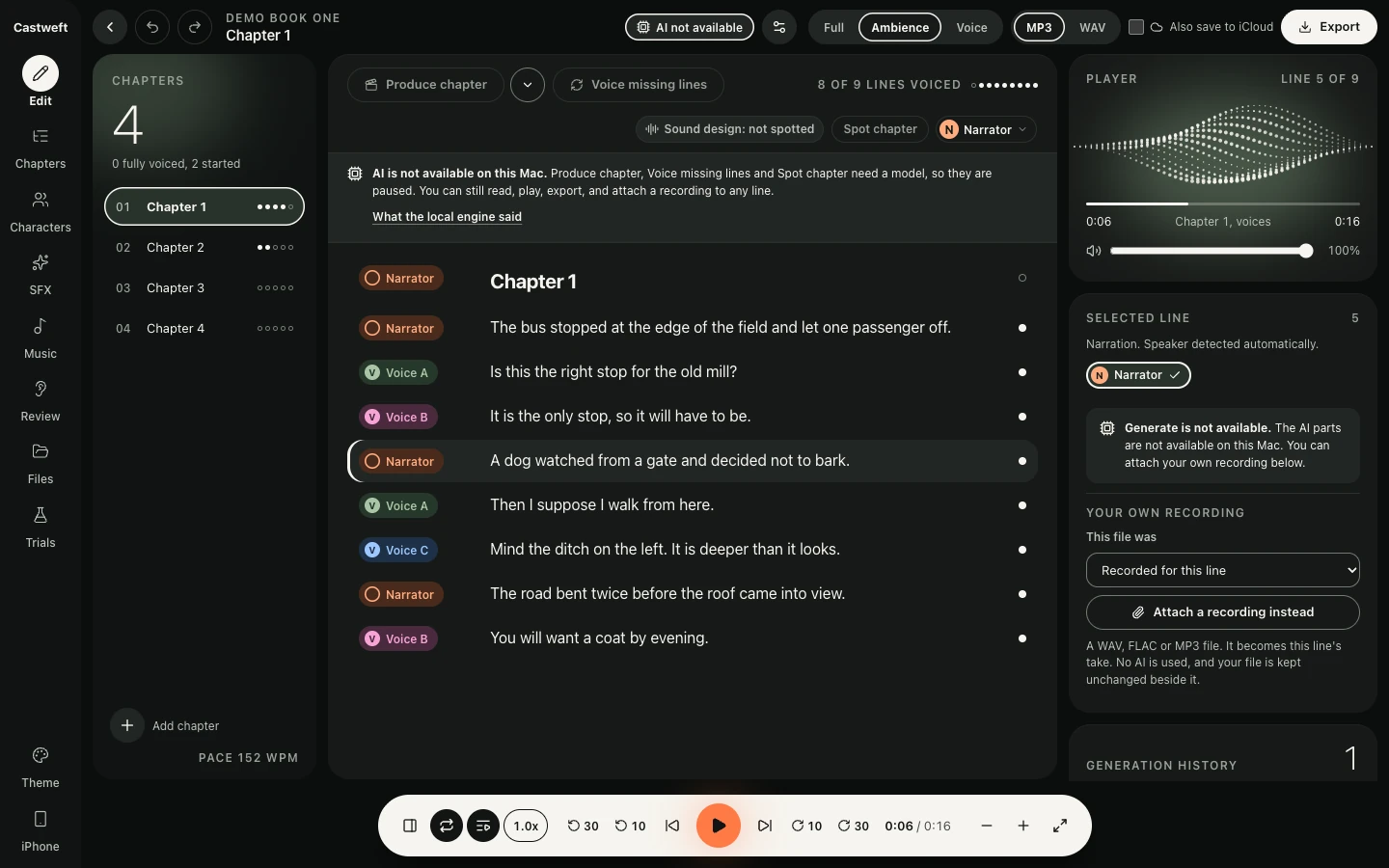
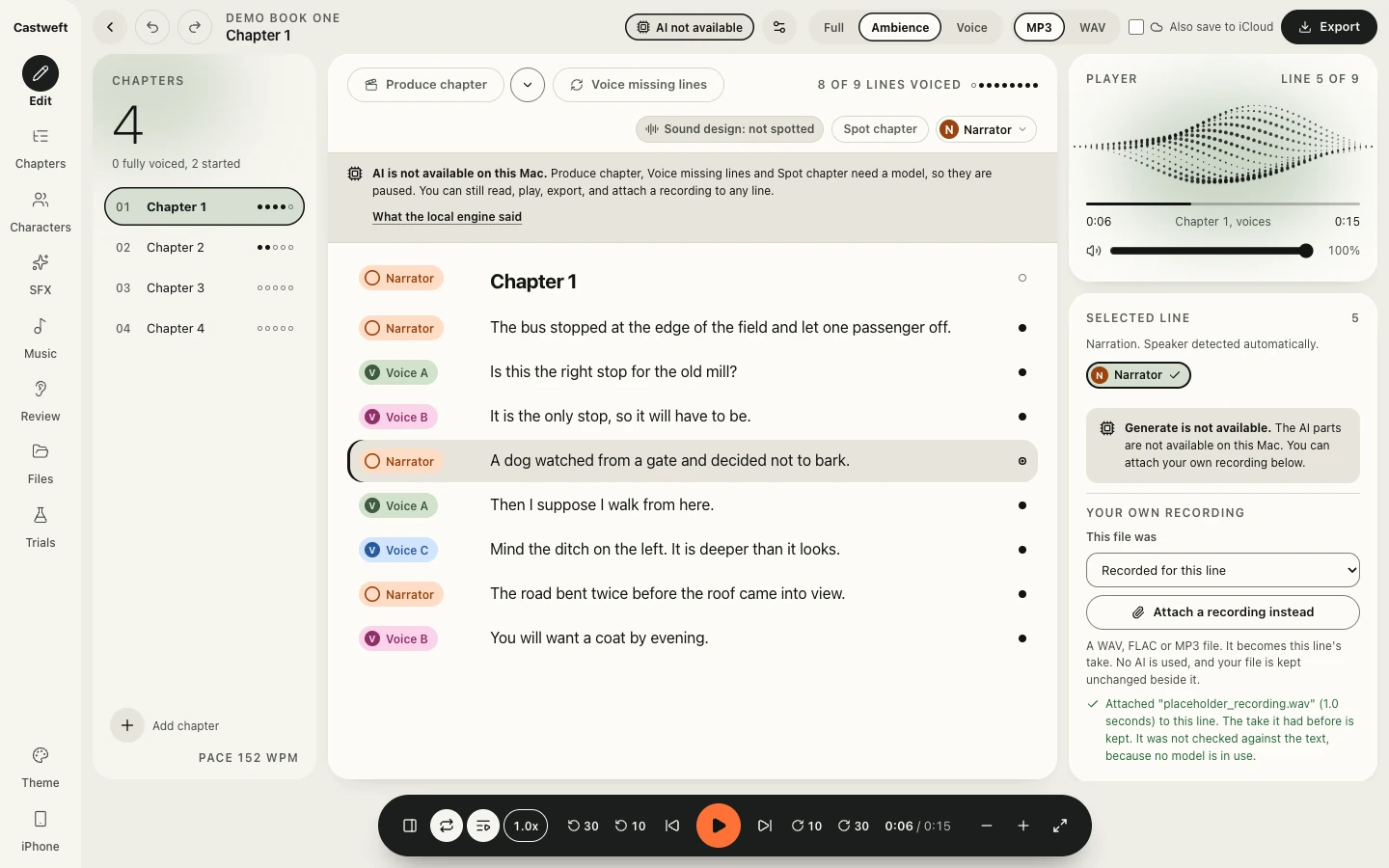
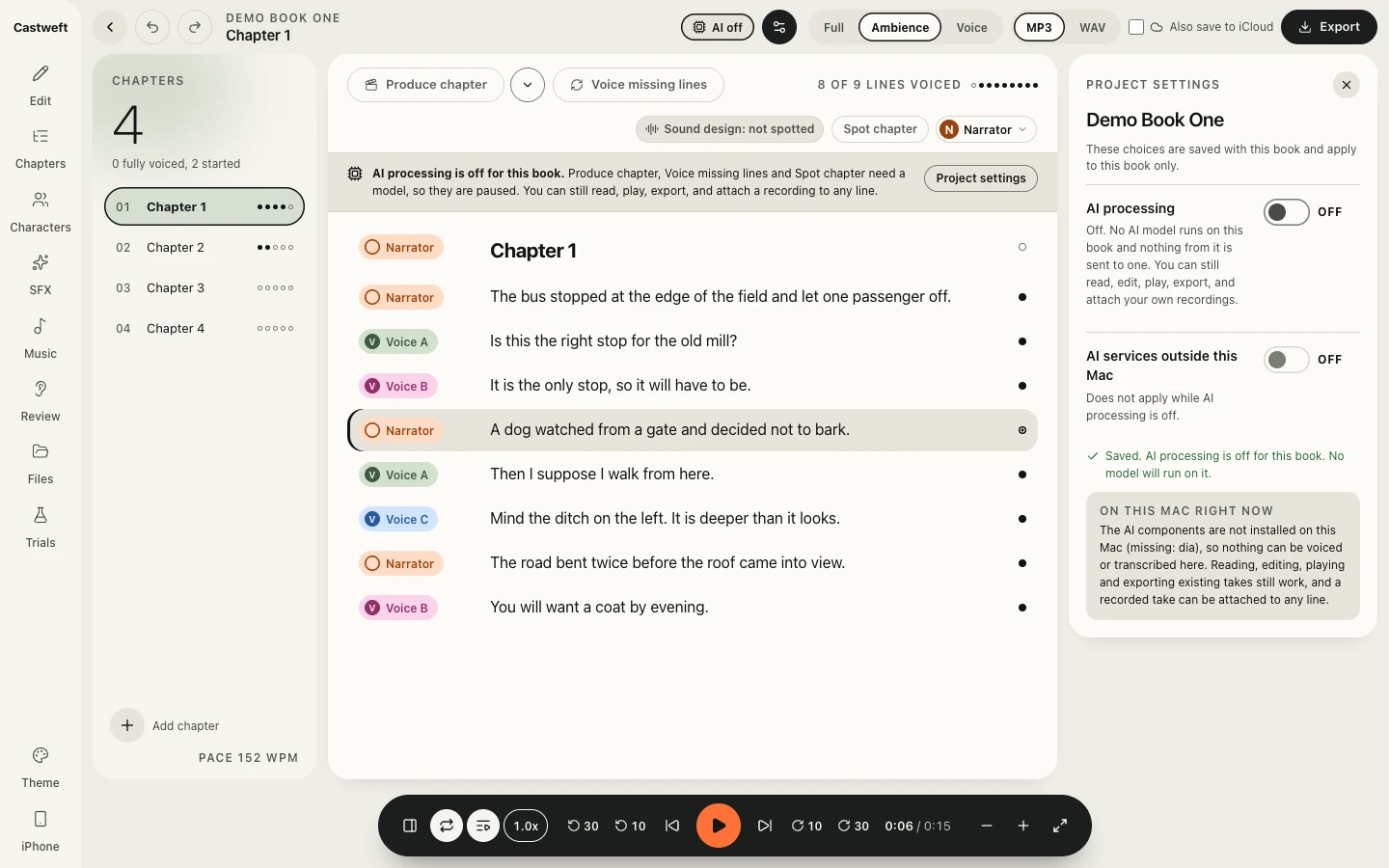
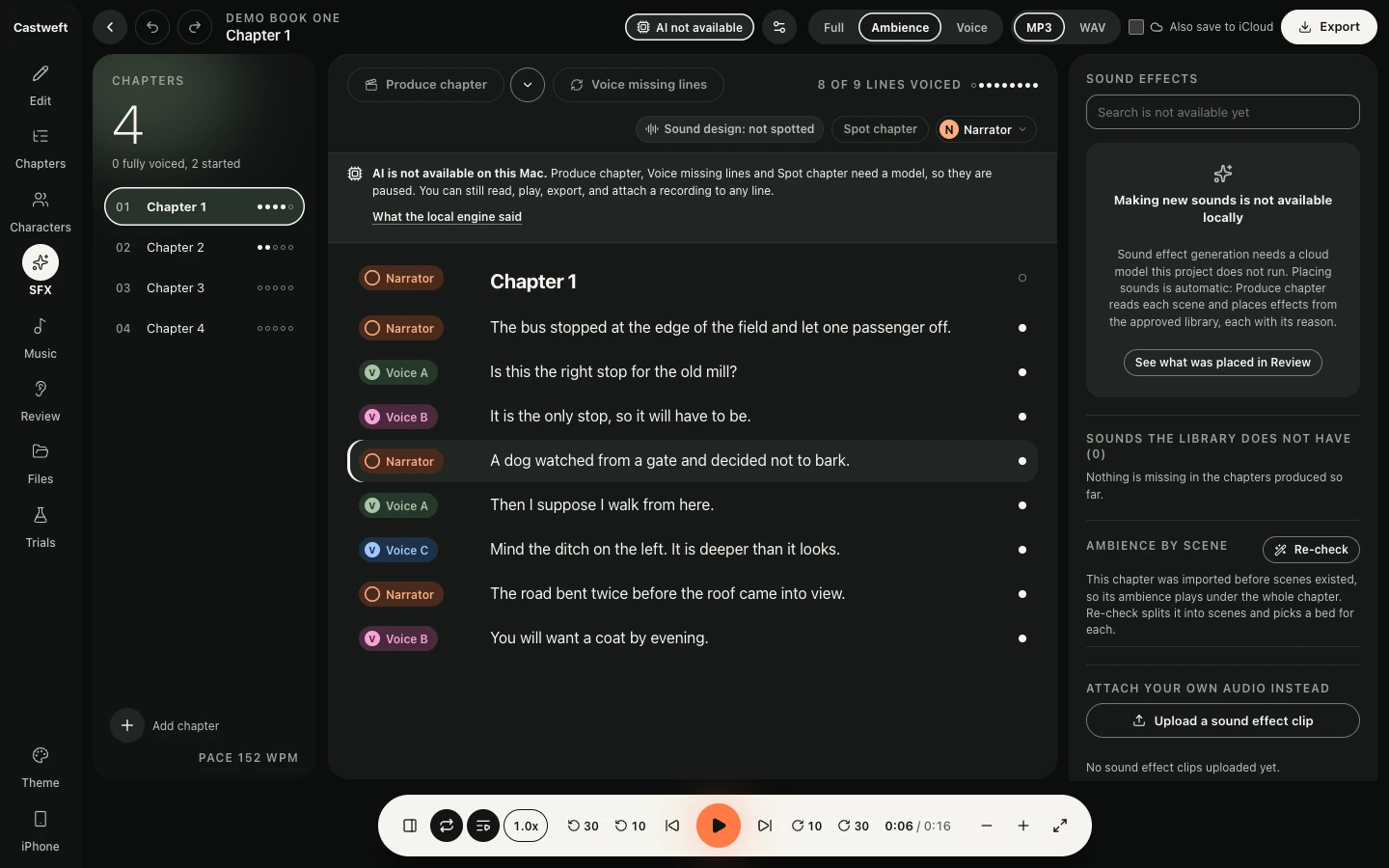
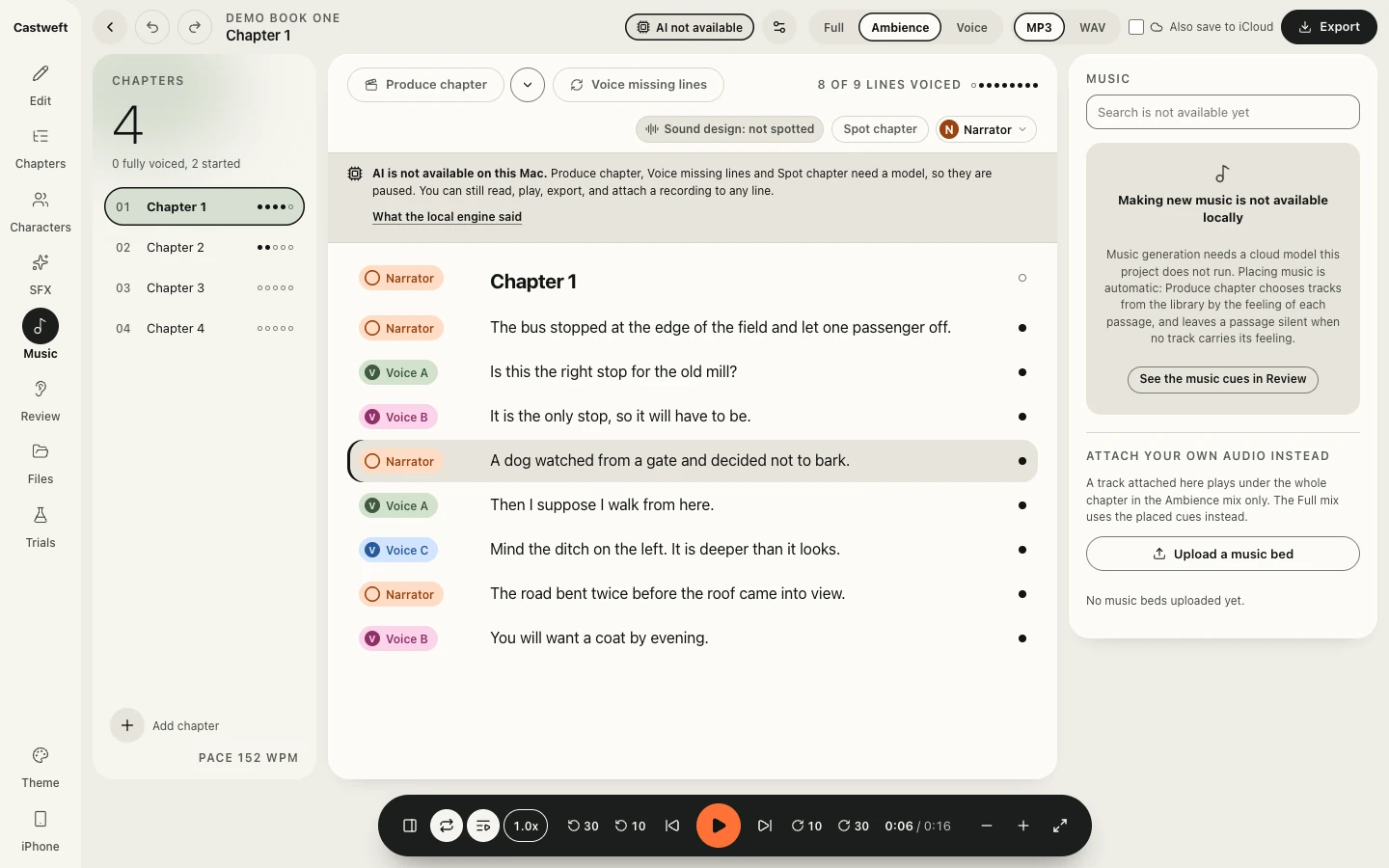
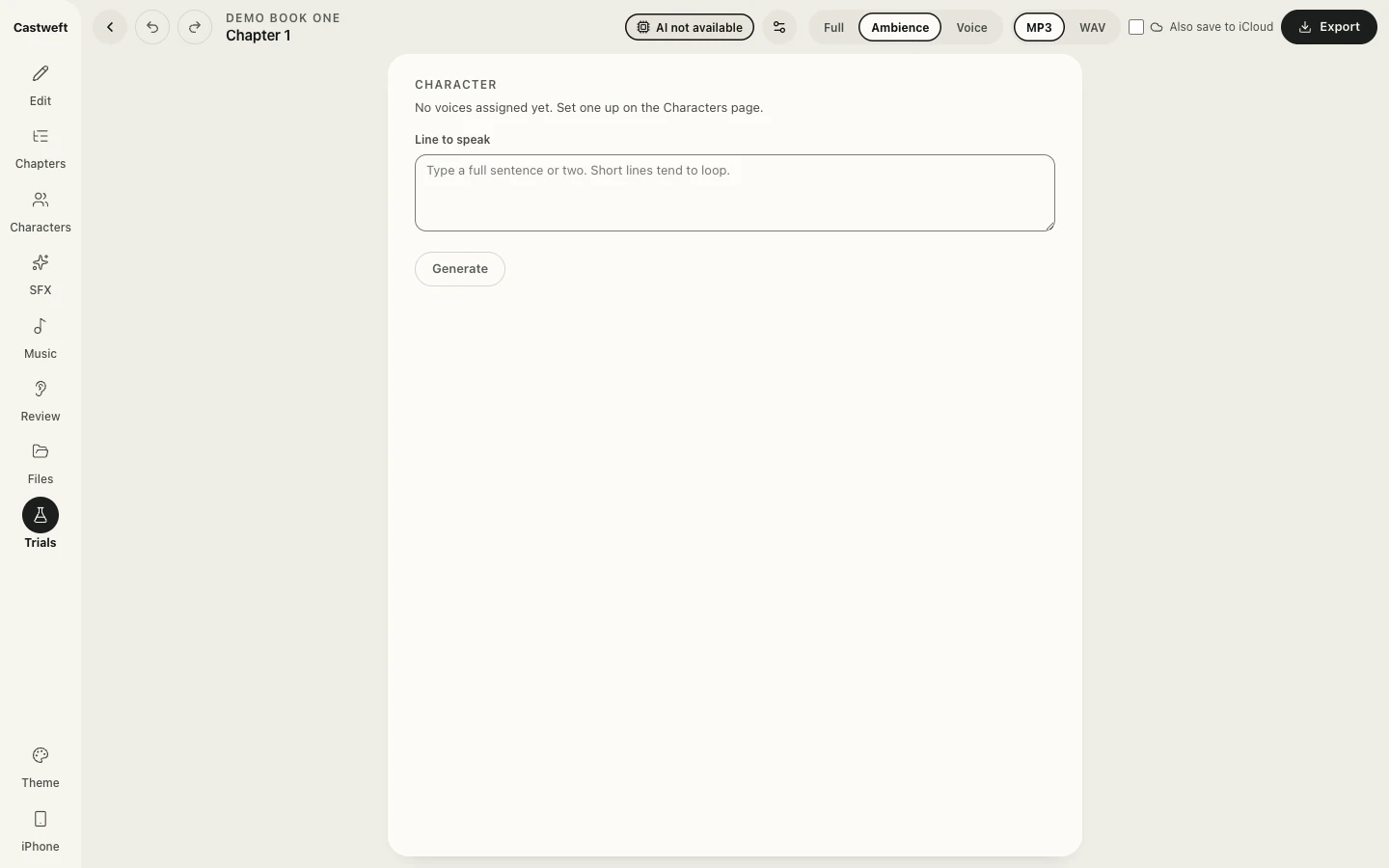
Tooltips, 10 October 2026: each control says what it does, and why when it is not available.
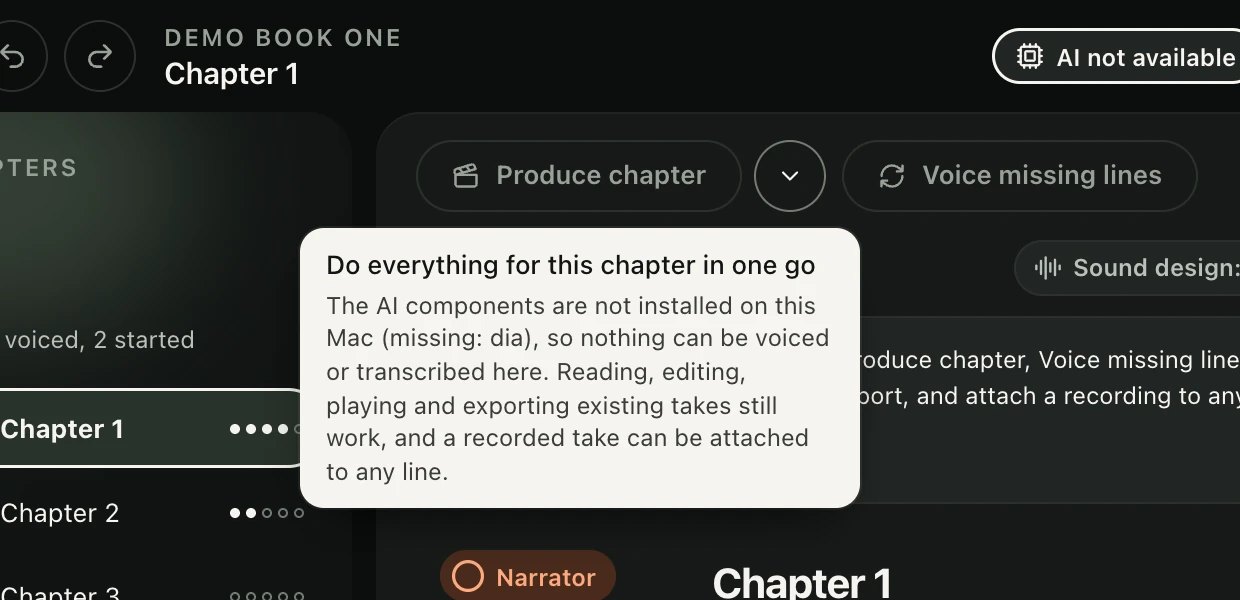
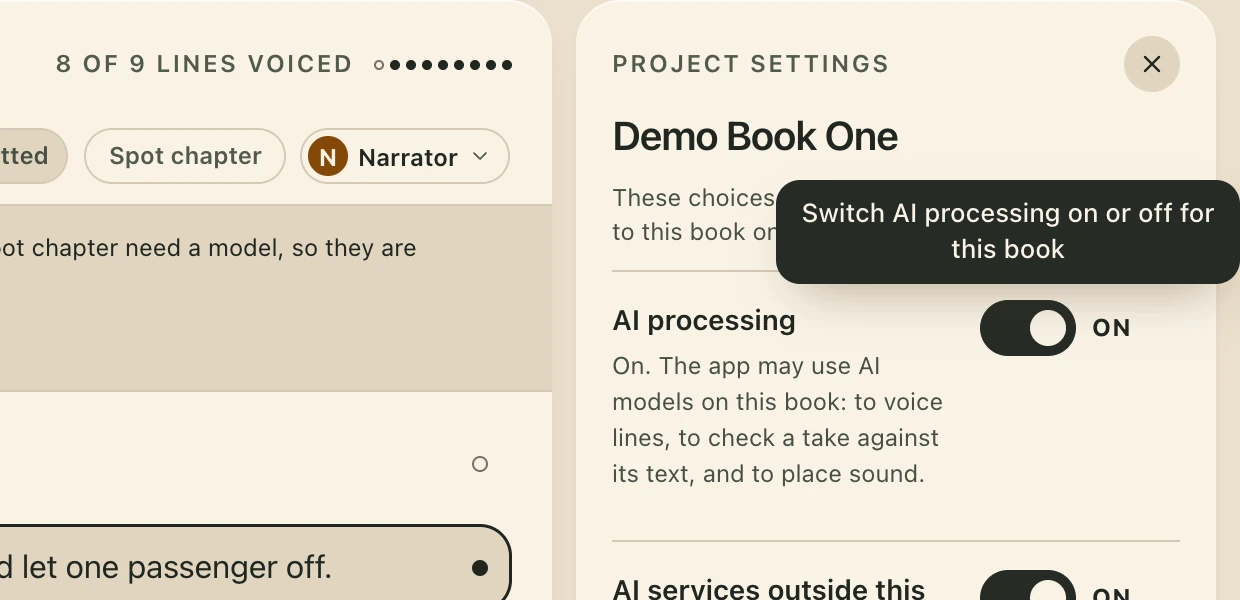
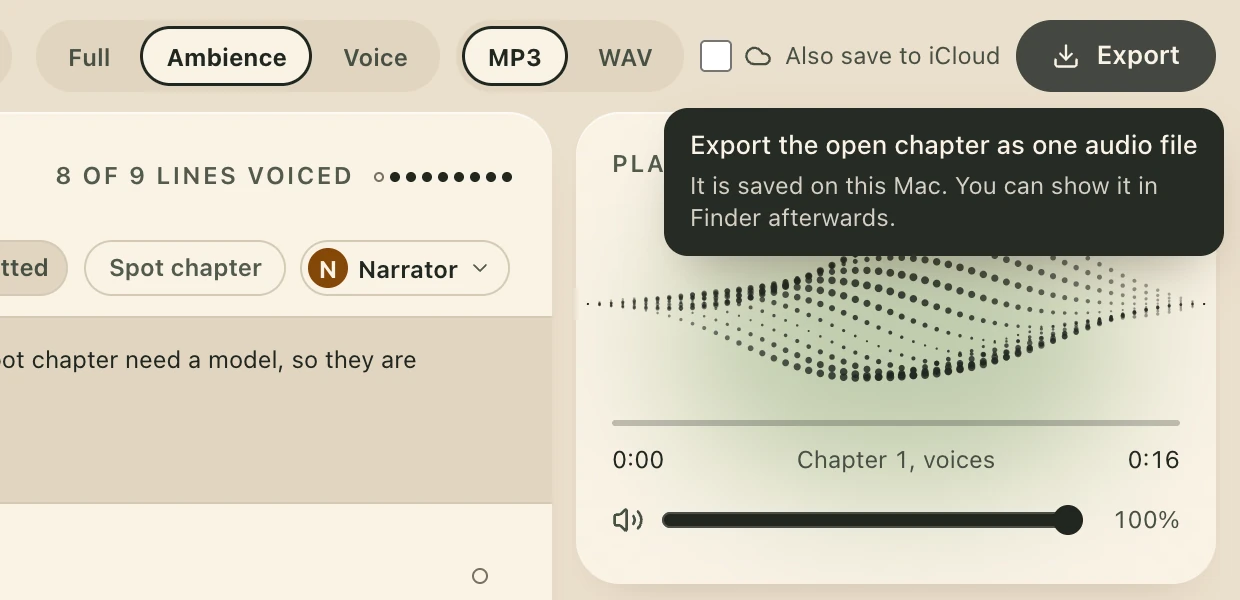
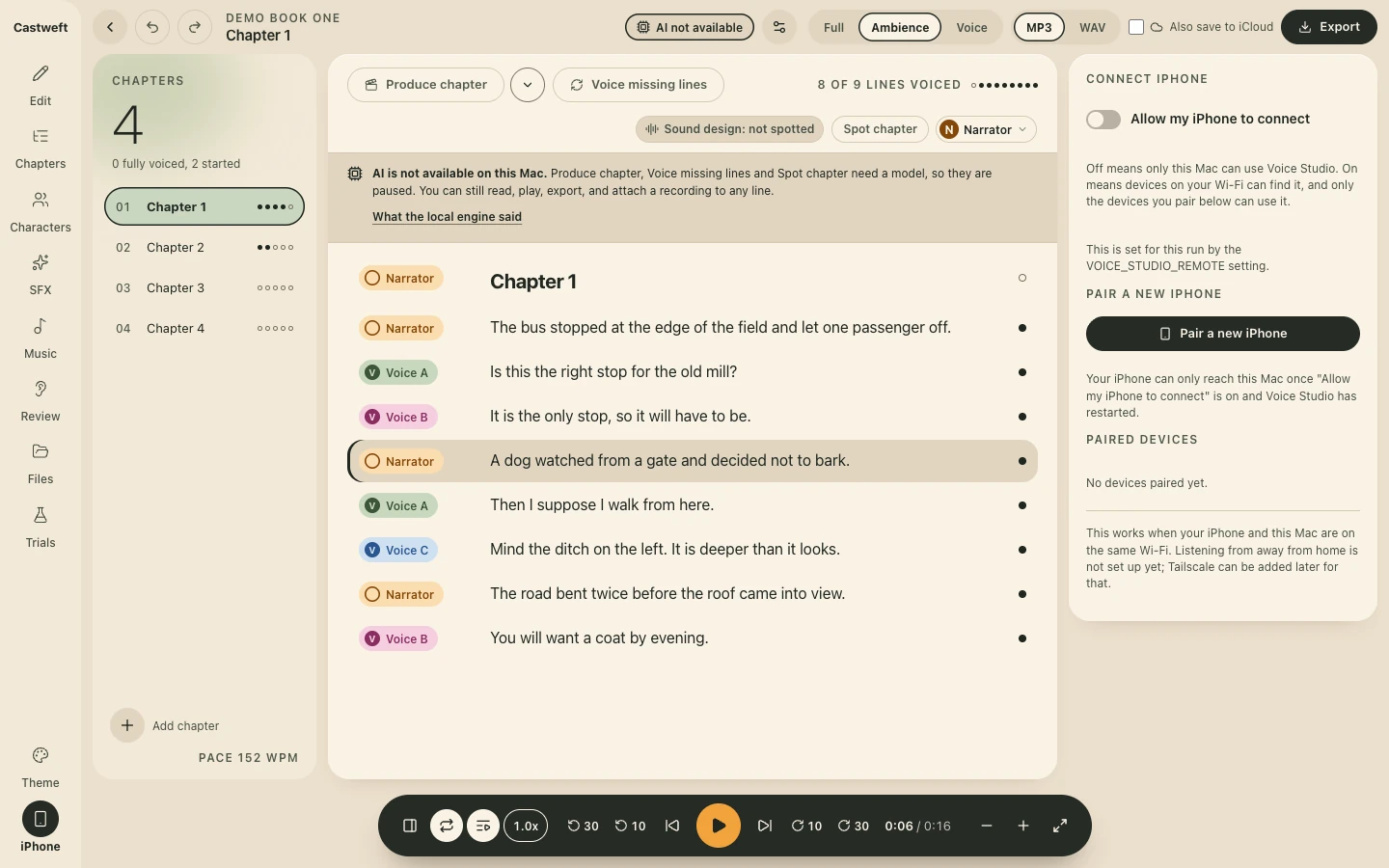
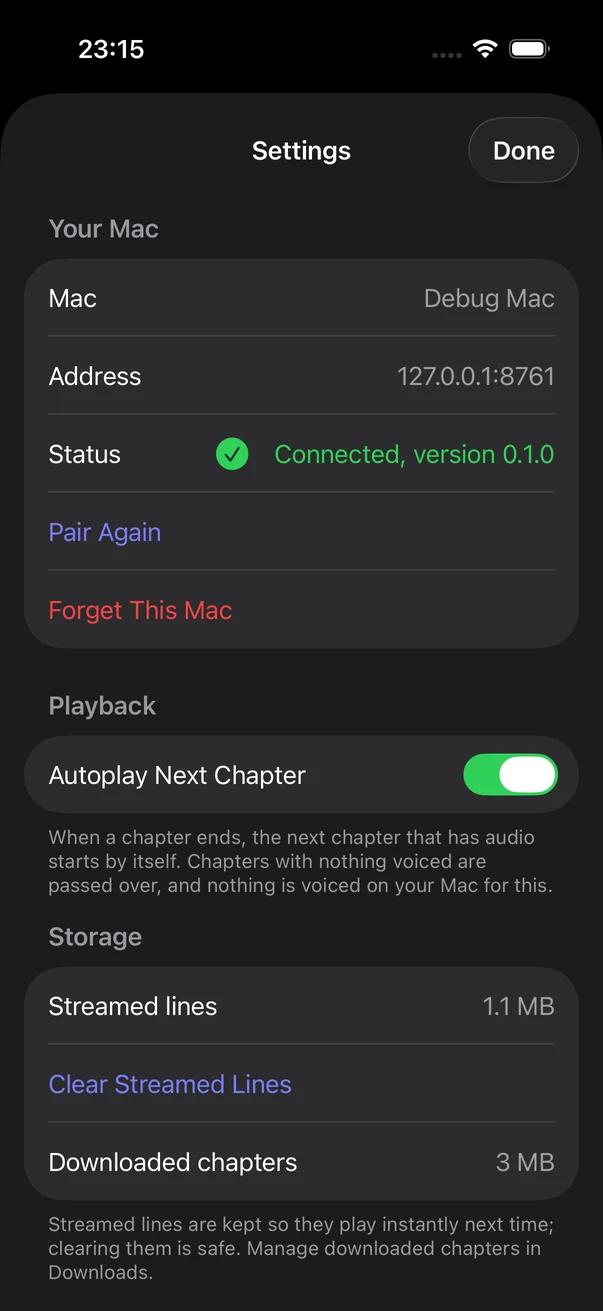
The Mac side of pairing, and the iPhone app in the simulator with a test address. The pairing panel still carries the app's first name, Voice Studio.
Concepts with placeholder content. None of this is built. The app today is the one shown above.